India’s Nutrition Crisis, Explained
According to the Global Nutrition Report, India has made considerable progress in meeting several maternal and child nutrition targets over the past two decades. For instance, the prevalence of childhood stunting declined from 47.8% in 2006 to 34.7% in 2017, with marginally better outcomes among girls (34.0%) than boys (35.4%). Similarly, the prevalence of exclusive breastfeeding increased from 46.4% in 2006 to 58.0% in 2017, placing India on course to meet internationally recommended benchmarks for infant feeding practices.
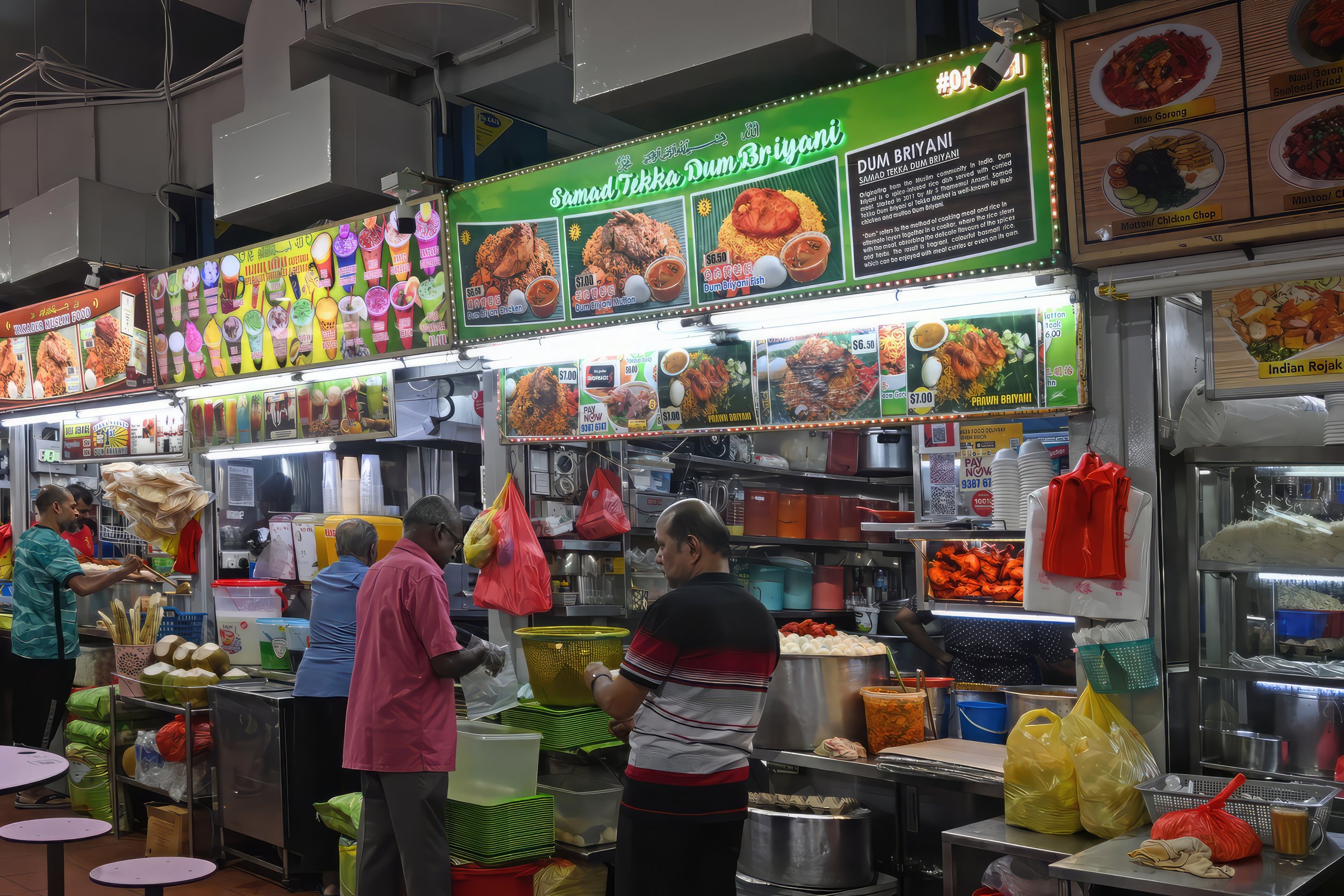
The food stalls at Tekka Centre, Serangoon Road, Little India.
However, these gains coexist with significant gaps in both nutrition outcomes and data coverage. The same report notes limited progress in reducing anaemia among women of reproductive age, alongside persistent deficiencies in data for several key indicators. For instance, nationally comparable data on the prevalence of low birth weight are currently unavailable, as are sex-disaggregated data for several core nutrition interventions. Also, India remains off course on most diet-related non-communicable disease targets, with adult obesity, raised blood pressure, and diabetes continuing to rise among both women and men.
It is in this context that the 2024 Dietary Guidelines for Indians assume particular significance. Prepared by the ICMR–National Institute of Nutrition under the aegis of the Ministry of Health and Family Welfare, Government of India, these guidelines represent the first major revision of the country’s national dietary recommendations in nearly a decade. During this period, India’s food and health landscape has been critically reshaped by the forces of globalisation, urbanisation, and the pervasiveness of social-media–driven food marketing—which, together with the rise of platform-based food delivery, has radically altered how Indians access, and consume food across the country (arguably, in ways that have largely been to their detriment rather than advantage). Indeed, the guidelines themselves note that 56.4% of India’s total disease burden is now attributable to unhealthy diets, driven by rising consumption of foods high in fat, sugar, and salt, declining physical activity, and limited access to diverse, nutrient-dense foods.Indeed, the guidelines themselves note that 56.4% of India’s total disease burden is now attributable to unhealthy diets, driven by rising consumption of foods high in fat, sugar, and salt, declining physical activity, and limited access to diverse, nutrient-dense foods.
As far as specific nutrition- related outcomes are concerned, evidence from the Comprehensive National Nutrition Survey (CNNS) 2019 and the National Family Health Survey (NFHS-5, 2019–21) show that anaemia continues to affect 40.6% of children aged 1–4 years, compared to approximately 20–25% among older children and adolescents up to age 19. Among adults aged 18–69 years, the prevalence of diet-related non-communicable diseases has worryingly increased between 2016 and 2021 for both men and women. Among men, the prevalence of obesity, hypertension, and diabetes rose steadily over this period. Among women, although obesity prevalence declined modestly from 28.7% to 24.0%, the prevalence of diabetes nearly doubled—from 9.7% to 13.5%—and hypertension increased from 15.3% to 21.3%, indicating a worsening cardiometabolic risk profile despite marginal reductions in obesity.
At the same time, the intake of micronutrient-dense foods—such as whole grains, pulses, nuts, fruits, and fresh vegetables—remains below recommended levels, while the consumption of refined cereals and processed foods has increased. This imbalance is not accidental: highly processed foods are often cheaper, more accessible, aggressively marketed, and more convenient than healthier alternatives.
Spending data disaggregated by rural and urban residence further illustrate the deep penetration of ultra-processed foods (UFPs) into everyday diets. Data from the Household Consumption Expenditure Survey 2023–24, released by the Ministry of Statistics and Programme Implementation, show that in rural India, households spend ₹406 per person per month on beverages, refreshments, and processed foods, accounting for 9.84% of total monthly per capita consumption expenditure (MPCE). In urban areas, this figure rises to ₹776 per person per month, or 11.09% of MPCE.
The category of beverages, refreshments, and processed foods now constitutes the single largest component of food expenditure in both rural and urban households, even surpassing spending on staples such as cereals, pulses, fruits, and vegetables. These figures highlight the structural entrenchment of UFPs within India’s contemporary food economy.
But what explains the rise of this “junk-food economy” in India?
According to a landmark three-part Lancet series authored by multiple global health experts in 2025, UFP industry is a central driver of this shift. Because UPFs are more profitable than minimally processed foods, corporations invest heavily in their production, distribution, and marketing. This profit-focused model encourages continuous expansion, making these foods widely accessible and aggressively promoted. The market for UPFs in India has exploded nearly forty-fold, from ₹7,996 crore in 2006 to ₹3.3 lakh crore in 2019. In other words, what was once a sub-$1-billion market has grown into a $38-billion industry in little more than a decade—representing a staggering increase of roughly 4,000%.
And this growth is not merely commercial. It is also behavioural. As Pulitzer Prize–winning journalist Michael Moss observed decades ago in his award-winning book, Salt Sugar Fat (2014), the processed food industry has long understood and actively exploited the capacity of processed foods to create cravings that can override consumers’ intentions to eat healthily. As Moss notes, “To be sure, there would be no getting around the role that packaged foods and drinks play in overconsumption. Some industry officials had already begun discussing the power of foods to create cravings and to overwhelm the best intentions of dieters.” Although written largely in a U.S.context, his analysis remains prescient for emerging markets like India even today.
Viewed against this backdrop, while the intentions of government publications such as the ICMR’s Dietary Guidelines or institutional studies like those by The Lancet are commendable, they unfortunately operate within a food environment dominated by commercial forces far too powerful to control. Without stronger regulation of food advertising, pricing, and product formulation, individual-level dietary advice in India is likely to remain undermined by structural drivers of unhealthy consumption.